Self-proclaimed “reluctant convert” C.S. Lewis wrote in his book Mere Christianity, “A man does not call a line crooked unless he has some idea of a straight line.” In other words, despite secularists claiming the contrary, the presence of injustice proves justice’s existence.
We are no strangers to these “crooked lines.” In fact, humans have created ways to make them palatable. Instead of dying, a loved one “passes away.” A company “lays people off,” instead of firing them. But what happens when language becomes oversaturated with euphemisms that undermine real, persistent evil?
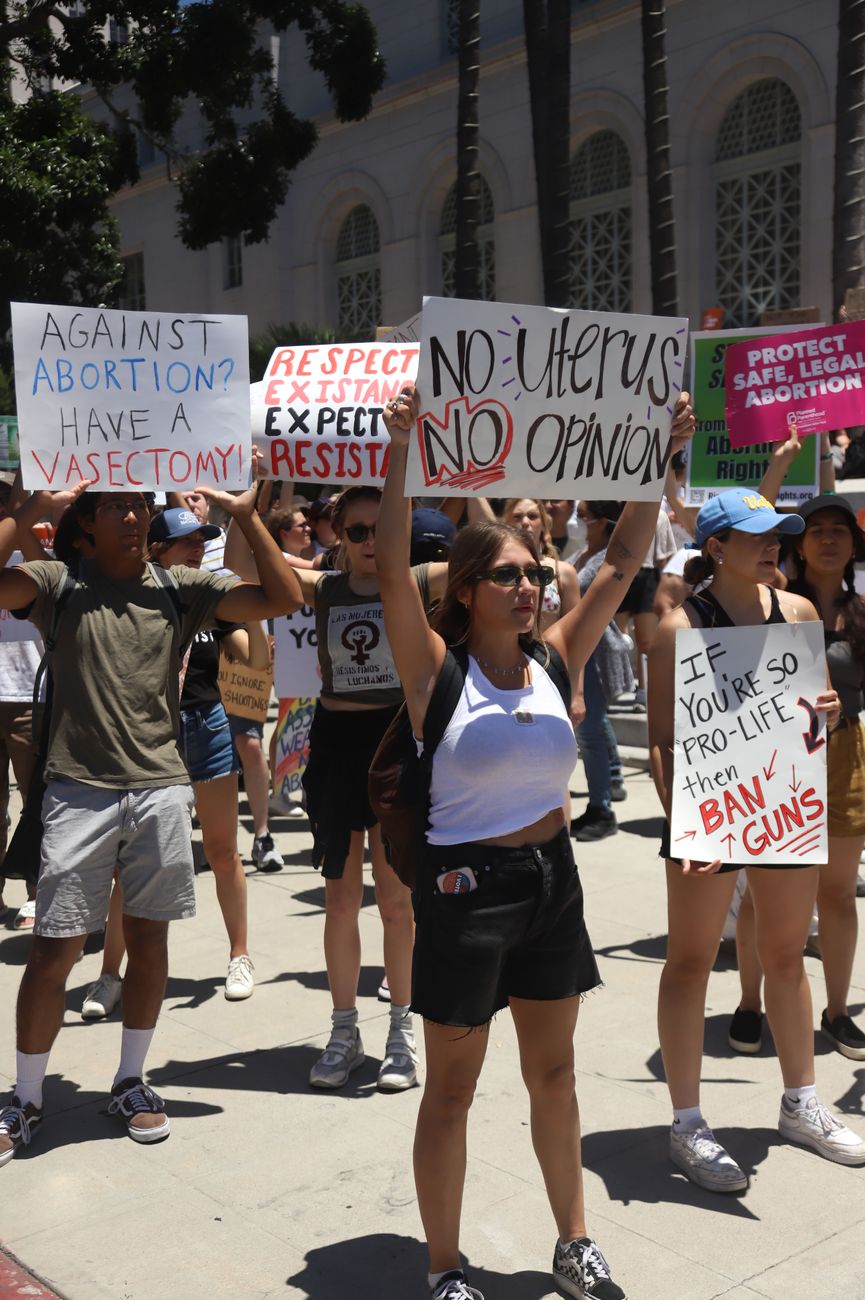
That’s exactly what the pro-abortion movement has done, and why Texas Representative Brandon Gill asked American University School of Public Affairs Senior Scholar Jessica Waters what her “favorite type of abortion” was in a recent hearing.
Gill did not retreat to curt clauses or flowery excuses when describing what abortion is and how it is carried out. When others tout that “abortion is healthcare,” pro-lifers know this is nothing short of an attempt to present a crooked line as straight.
In horrifyingly accurate detail, Gill describes a suction abortion, which uses “suction, twenty-nine times the power of a household vacuum cleaner, [tearing] the baby’s body apart and sucks it through the hose into a container.”
Waters, a researcher of reproductive rights law, simply replied, “I stand by my testimony.”
Abortion continues to be one of the most controversial topics in America’s political arena, and yet the premise does not warrant controversy at all. Whether it’s reproductive rights, bodily autonomy, or women’s healthcare, none of these objectively incorrect disguises can mask the injustice below it.
Each of these rebuttals to the pro-life argument isn’t just euphemism, but inherently false. Dr. Richard J. Poupard argues this point flawlessly in his 2007 Christian Research Journal article, “Suffer the Violinist: Why the Pro-abortion Argument from Bodily Autonomy Fails.”
Firstly, if a mother truly has bodily autonomy, and the child she is carrying is no more than an organ leeching off her energy stores, there is no point in advising women against the consumption of alcohol or other toxic substances in pregnancy. There should be no lament over fetal alcohol syndrome or withdrawals. The mother has full authority over her body, and any harm to the unborn child is no more than collateral damage, the equivalent to a diseased lung for which we do not punish a smoker.
Yet, autonomy is not a license to kill.
Secondly, the pro-abortion argument dismisses the scientifically validated personhood of an unborn child. This is the basis of the entire argument. Is the fetus a person, or merely the “clump of cells,” abortion advocates deem it to be? The embryological and theological truth is that the unborn are human beings. They are clumps of distinctly designed human cells. There is no stage during gestation in which this changes. Not when they begin to experience pain. Not when their heart begins to beat. Not when they are mere millimeters from exiting the birth canal.
The beginning of life is life itself. If it were not so, abortion would have no life to end.
Even the most well-studied proponents of abortion know this. In his book, Writings on an Ethical Life, atheist philosopher Peter Singer says, “There is no doubt that from the first moments of its existence, an embryo conceived from human sperm and egg is a human being.”
Dr. Bernard Nathanson, a former abortionist and co-founder of the National Abortion Rights Action League, resigned from his position after wrestling with the reality that human life begins at conception, stating, “Modern technologies have convinced us that beyond question the unborn child is simply another human being, another member of the human community, indistinguishable in every way from any of us.”
The most widely cited and used embryology textbooks (e.g., The Developing Human, Langman’s Medical Embryology, and Human Embryology & Teratology) state that life begins at the moment of fertilization. Yet even Christians who boldly profess, “For you formed my inward parts; you knitted me together in my mother’s womb,” (Psalm 139:13) from the pulpit trifle with semantics when confronted with the issue.
No one is immune to the self-deception that makes a crooked line appear straight when reality is uncomfortable.
This is why statements like Representative Gill’s are not just jarring; they’re convicting. 1.12 million babies were aborted in 2025 alone; 1.12 million unique human beings with distinct, inimitable DNA. Still, America’s postmodern, secularist culture vacillates between whether the loss of these lives is worth celebrating under the guise of women’s rights, or the mark of a society desensitized to murder.
In Season One of HBO’s critically acclaimed TV show “The Pitt,” a 17-year-old girl rushes to the ER in search of an abortion pill before she reaches twelve weeks gestation, the legal cutoff for the state she lives in. Her doctor, who happens to be pregnant herself, notes the ultrasound shows she has already entered her second trimester, and therefore cannot administer mifepristone, a common abortion pill. This conflict prompts the attending physician, Dr. Robby, to take a “second look” at the ultrasound. He then purposefully mis-measures the unborn child’s size, allowing the girl to receive the abortion and “let her have a life.”
Later in the episode, the doctor who first saw the patient has a miscarriage and weeps over her lost baby in the bathroom. Abortion advocates will rightfully mourn the loss of every child until it is suddenly inconvenient.
It’s a dichotomy that plagues American society. Many people are so self-consumed with their lives that they deny the most vulnerable among them the chance to have one. They cry with mothers who suffer miscarriages, but praise women who receive “abortion on demand, without apology.”
This behavior isn’t exclusive to abortion either. Parents tell children their bodies are perfect, that they should love who they are. But in the case of transgenderism, society applauds whatever physical and chemical measures are taken to affirm the deception of gender dysphoria. Suicide is rightfully grieved, but physician-assisted euthanasia is heralded as the epitome of dignity.
The world is constantly attempting to make crooked lines straight. It is so uncomfortable with its inability to save itself that it compromises human dignity to obtain some semblance of satisfaction. Christians must resist this temptation.
Christ in His perfect holiness did not attempt to beautify the crucifixion. His death was a gruesome, drawn-out torment. Horrifying, humiliating, haunting. This alone illustrates the lamenting of sin and injustice without faltering, especially when it’s socially inconvenient.
But hope does not waver. His defeat of death itself demands the valuing of human dignity at every stage of life. He calls us to defend the most vulnerable by advocating for their right to life, their right to exist.
Christians must fight the temptation to evade the issue, even if our culture has made up its mind. The attempts by society to wriggle its way out of these morally bankrupt ideas through clever euphemisms cannot be ignored. Ironically, the more confused and corrupt our culture appears, the more confident we can be in our faith. We should not be surprised, but empowered.
The world makes foolish attempts to mirage crooked lines as straight. But we have a living hope in Christ that one day, such injustices will be made right again.