While visiting Hungary recently, I stopped to watch a string quartet perform works ranging from Liszt’s Liebestraum to Brahms’ Hungarian Dances. I confess that I danced and sang along, somewhat ineptly, with the gathering crowd. In that moment, strangers from different walks of life shared something profound: Music possesses a rare power to shape, move, and unite people. My experience in Budapest reveals what we risk losing in America. If our civilization is to flourish, music must be revived.
Music has been called the “universal language,” not because every culture speaks it the same way, but because it communicates through patterns of sound, harmony, and emotion that transcend words and eras. Research confirms that every observable society creates music and that certain musical elements recur worldwide. One such element is tonality or the organization of pitches and harmonies around a central “home” note, or tonic, which gives music its sense of direction and resolution. Whether in a Hungarian folk song or an American hymn, tonal structure provides a shared frame of reference, making melodies feel complete and emotionally resonant. This recurrence suggests a deep, objective link between musical order and human experience.
The ancients knew this well. Plato and Aristotle both discuss how the proportions and harmonies of music are reflected in human nature. They identify essentially four benefits of music: It moves the emotions, gives pleasure, disposes the soul toward virtue, and cultivates the intellect. Other writers emphasized music’s role in passing down cultural heritage, instilling values, and fostering social cohesion. Many modern artists have forgotten these insights.
Aristotle observed in Politics, “by experiencing the passions in music, we become accustomed to feeling them rightly.” Good music’s patterns of rhythm and harmony draw the scattered impulses of the heart into a common pulse, guiding and shaping our minds, emotions, and souls. Boethius made the same point: “Music is part of us, and either ennobles or degrades our behavior.”
This influence was recognized on a societal scale as well. Confucius is credited with saying, “If one should desire to know whether a kingdom is well governed, if its morals are good or bad, the quality of its music will furnish the answer.” He was so confident in music’s ability to shape and reflect society that he measured a nation’s well-being by its musical quality. If Confucius judged our society, what would our music reveal?
Plato agreed in The Republic: “When modes of music change, the fundamental laws of the State always change with them.”
That is why music has long been considered a pillar of liberal arts education. Music teaches without argument. It rehearses the right proportion of joy and sorrow, of tension and release, until they become second nature. Over time, this schooling of the emotions strengthens the virtues that hold a person and, by extension, a community together.
But that is not what is happening broadly in modern society.
Music participation, education, collective enjoyment, and quality have all declined in recent decades. Research shows that music learning and participation among children have fallen substantially since the 1980s, while Americans attend far fewer musical events, such as jazz concerts and operas. The pandemic accelerated these trends. Over three and a half million public school students now lack access to music education, and even where opportunities exist, many opt out.
These statistics suggest that our civic structures, such as schools, churches, and concert halls, are weakening or neglecting music, disconnecting people from the shared harmonies that once cultivated virtue and community. This institutional decline is mirrored by a cultural shift toward solitary listening.
Earbuds and streaming services make music accessible everywhere, but they cannot replace the sense of belonging and shared purpose found in choirs, ensembles, or concerts.
Much of today’s mainstream music also suffers from a decline in craft and a distortion of purpose. Instead of ordering passions toward goodness, it often agitates them in ways that drown out goodness and beauty. Listeners are encouraged not to contemplate or participate in meaning, but to surrender uncritically to sensation. Rhythm is used to excite rather than steady; melody is reduced to repetitive fragments or abandoned; lyrics often celebrate vice.
Even technical excellence is bent toward spectacle rather than the service of beauty. In such a climate, music ceases to be a common language of the community and becomes a private stimulant, isolating each listener in the echo chamber of his own appetites.
The present state of music is both a symptom and a cause of our cultural malaise. From Plato to Confucius, thinkers have recognized that music and art are central to human development. They shape the soul and the city alike. America’s educational shortfalls, moral drift, mental health crisis, endemic isolation, social fragmentation, and rising anxiety are not unrelated to the loss and corruption of music’s formative role.
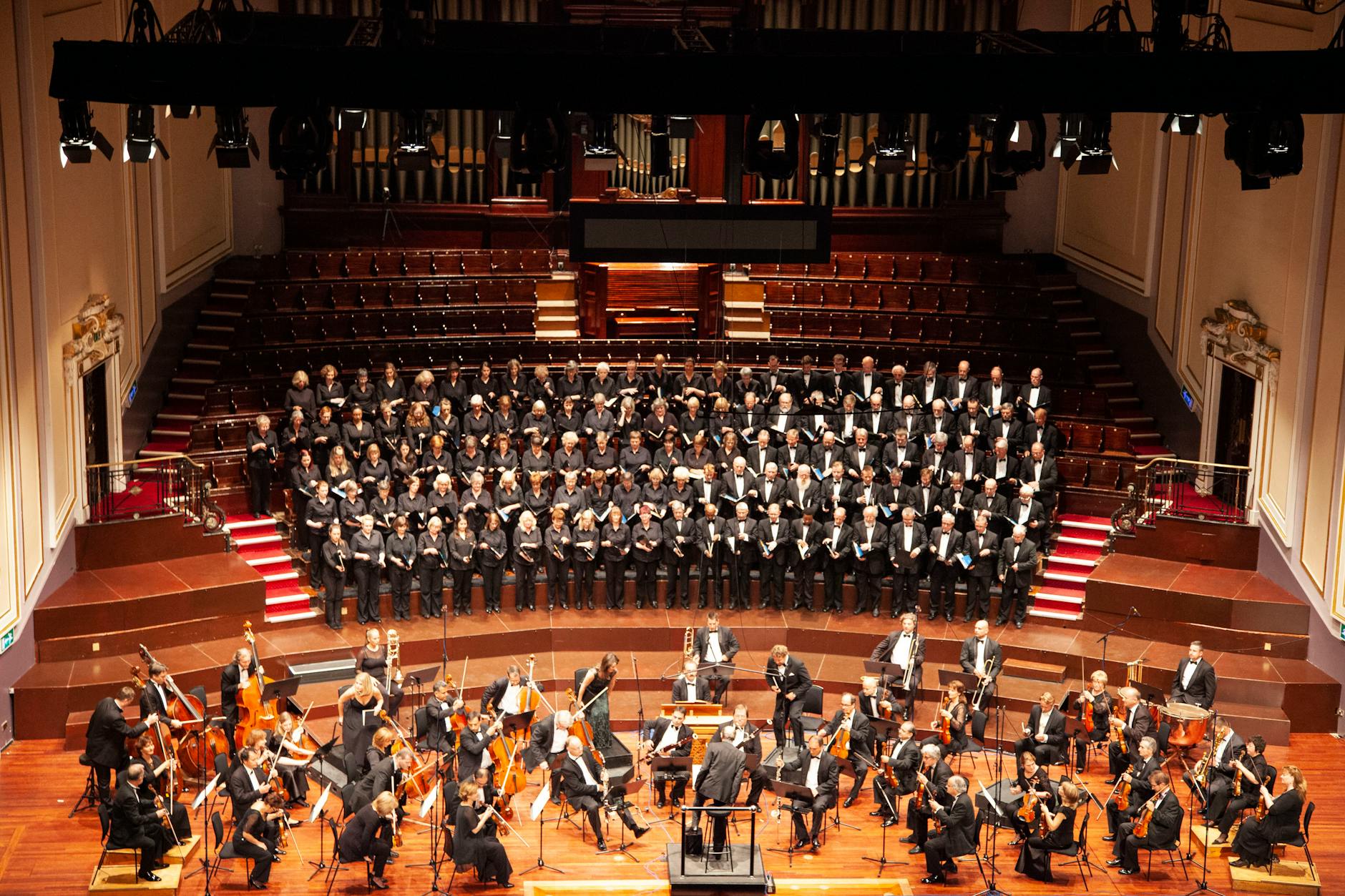
Music’s highest purpose, as a colleague aptly put it, is “to bring a fractured world together.” Our own history offers proof. The Star-Spangled Banner carried the memory of Fort McHenry, rallying Americans from the War of 1812 to today. Antonín Dvořák’s New World Symphony (1893) wove together Native American melodies, African-American spirituals, and Bohemian folk traditions, producing a uniquely American masterpiece that has inspired generations. Such works demonstrate that music can unite without erasing differences and elevate without condescension.
Renewal begins with us.
We can join a choir or band, support artists who share our vision, and learn from those who know beautiful music well. Educational reform is essential, but we need not wait for institutions to act. Recently, some fellow students and I began a hymn study and singing group, sharing these songs with the community. Choral singing like this unites and orders voices into harmony, preserves heritage, and conveys truth. In these settings, one cannot help but feel a sense of belonging and shared purpose. Small acts like these can reweave excellent music into the fabric of daily life.
We can hardly forsake music without abandoning part of our humanity. As Boethius reminds us, music can shape us toward virtue or vice. Let us choose the former and seek the best that music offers.