In over a decade of music through church and school choral singing, I have never performed a set of pieces as explicitly aligned with Progressivism as I did earlier this month.
In all honesty, I should not have been surprised. As my colleague Stavros has noted, music is “reflective of the soul” of its culture. It will by nature reflect what a culture thinks about beauty, as it is shaped by the intent of its creators to be beautiful. In a society that thinks of beauty as the fullest expression of each human’s individual experiences and relative beliefs, the collaboration that happens in a choir almost seems like a communist ideal, with sometimes hundreds of people coming together to share individual expression under one director and in the vision of one composer. As John Dewey posits in Art as Experience, the quality of such art is intended to be found in the experience of the individuals bound by one civilization.
So there I sat: in a church, with multiple “genderfluid” individuals, singing about how I longed for home (which was fine, I did) and saw their true colors shining through “like a rainbow” (less acceptable, though no less true). I had been invited to this gathering of the All-State Collegiate Choir, and I almost wished I had not accepted.
The Truth of Beauty
As I sat, I wondered how they all had gotten to this point. What has Western civilization done in teaching music that it no longer carries the same weight? In the Western traditions of education, music is part of the study of harmony and order in nature, and the creation of music is an attempt to capture or understand that harmony. Christians have historically added an extra layer of understanding: the creative act of composing a piece of music is akin to the creative act of God. Both bring order out of chaos, with humans only able to order the dimension of sound and God being able to capture everything out of nothing, ex nihilo. One might even think that music, by its nature, would be the antidote to nihilism and relativism.
But of course, people must be taught the truth to understand it. Most schools remove the technical understanding of music from the fact that it makes a particular religious or philosophical confession. At a national level and in my own state, curriculum standards focus on skill mastery. How well can you play, or improvise, or notate, or read notation? How well do you make meaning out of what you see in the text or harmonies, the intent of the author, and the like? That is how well you know music, in a modern school.
Such a state of affairs makes sense. If, as a teacher, you are told to assess students regarding their understanding of music but you cannot connect it to truth and goodness, your assessment can only be on their ability to create relativistic meaning, expressivity, or their technical capability.
What are we singing?
I snapped back to reality as the director started working us through “All Seems Beautiful to Me”, an Eric Whitacre piece based on the radically individualistic poem “Song of the Open Road” by Walt Whitman.
“From this hour I ordain myself loos’d of limits and imaginary lines,
Going where I list, my own master total and absolute,
Listening to others, considering well what they say,
Pausing, searching, receiving, contemplating,
Gently, but with undeniable will, divesting myself of the holds that would hold me.”
The contrast was stunning.
On the one hand, Whitman gave us a powerful confession of our independence from all authority and order; the progressive creed.
On the other, there was our director, “limiting” and “holding” us to a particular score of the music, a particular performance, which was itself a limit. A simple moment, but it exemplifies the inherent cognitive dissonance. Few if any in the room were aware of how obvious it should have been. They had not been taught.
If we are to continue holding music in high regard, and we ought to, the content of the lyrics must be taken into account. Children of all ages are capable of mastering technical skills through almost any set of songs. Every teacher must ensure those songs are also aligned with the Western Christian Paideia so that the individualistic nature of society is countered by harmony, order, and lyrics together. Students who are encountering and questioning the world may be taught about other cultural traditions, but it will become clear through exploration which traditions align with the nature of music and which do not.
At the end of the day, a larger part of the music is also the harmonies and not the lyrics they bear. Jazz, R&B, Rock, and all the other styles of which America is so fond were all developed with democracy, radical individualism, and in some cases near-anarchy in mind. I will leave finer points of harmonic analysis to my more musically adept colleagues, but from a purely philosophical perspective, music must be appreciated, judged, and taught in a way that reflects true beauty in its properly ordered sense.
The educational foundation of music must be considered not only from the perspective of the abilities certain pieces teach but also the lyrical and harmonic culture on which students will imprint. As with all teaching, they may later appreciate the best of other cultures (or understand the worst), but appreciation will have no weight unless they have, early in their lives, received a proper basis in music aligned with the culture that best understands beauty. Exposure to everything right away will only reinforce relativism. Exposure to the music of the Western Christian Paideia first, against which all other music can be judged, will help students avoid an anti-Christian view of music, beauty, and culture.
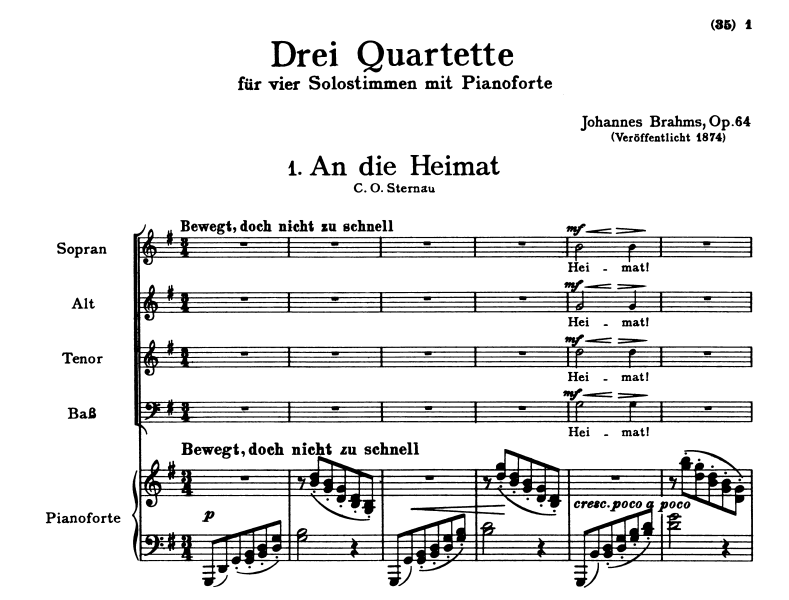
By the time of the All-State concert, I developed a deep love for one of the pieces we performed. It was An die Heimat, by Brahms. The sheer longing for the peace found at home, the grand “old songs,” and even an implied love of nation and culture, were carried with overwhelming power by both lyrics and music. I wanted to go home to my nation and rest.
At the same time, it gave me hope: even separated from home, feeling lost in a sea of progressives, a song of the failing West was still with me. Not all is lost. Our music remains. With intentional teaching, it may be the easiest piece of our civilization to regain.