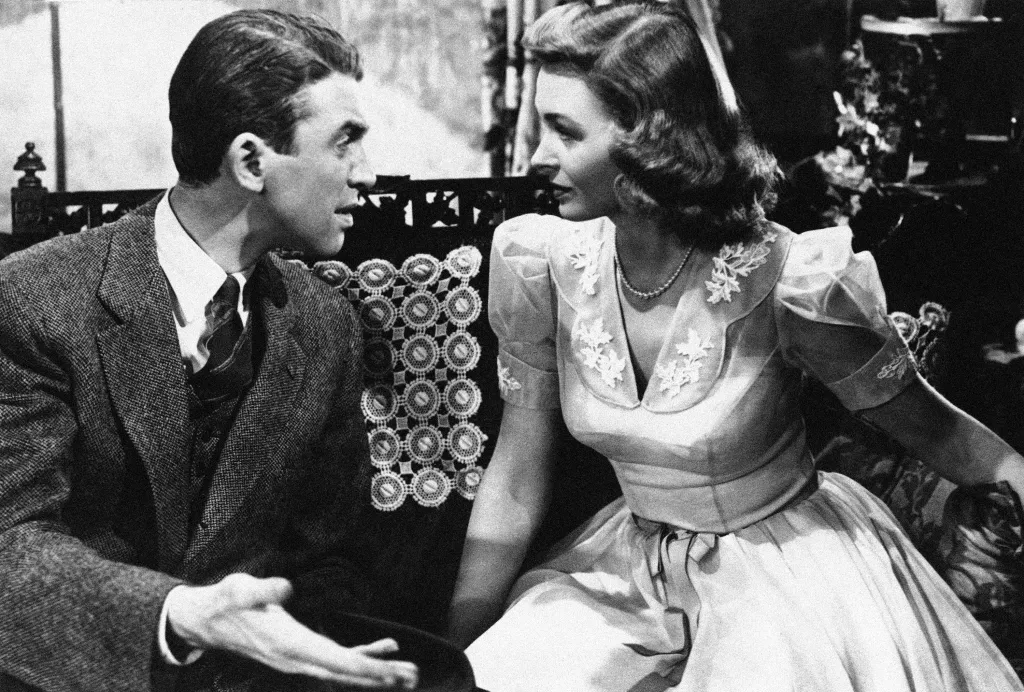
Coming out of the Christmas season, most people have recently watched one of the few pre-1970s movies they have ever been exposed to, It’s A Wonderful Life. The film was released in 1946 to moderate success, but in the following decades, it has grown into a cultural cornerstone. Even the most casual moviegoer is familiar with the plot, which centers around George Bailey, and his guardian angel who shows him that success comes from leaving a positive impact on those around you. It’s a touching story that still draws at audiences’ heartstrings despite being available for over seventy-five years.
This phenomenon raises the question: Why do classical movies still hold any cultural relevance? Why do people bother with movies that are shot in black-and-white, lack any special effects, feature long-dead movie stars, and present an outdated portrait of American cultural life?
When people sit down to watch It’s A Wonderful Life, it is often hard for them to adjust to its setting. The shock of stepping back in time can be distracting, especially at first, as viewers must shed their expectations of 4K high-definition color images, modern camera techniques, and highly stylized special effects. Rather, they must offer the movie the kind of suspended disbelief they offer fantasy films. They must indulge in a world that is, ultimately, not reality. George Bailey’s life, which is centered around family, small business, and a close-knit community, is no longer prevalent in American culture.
Yet, this traditional society which feels so foreign is the very element many audiences are attracted to. The movie is set in the tiny town of Bedford Falls, where the kids play in the street, everybody knows their neighbor, and people go out to dance on Saturday night, yet still make it to church on Sunday morning. It is a world that is centered around community. George Bailey met the woman who would become his wife, Mary, when they were both children. The same man has owned the same drugstore for all of George’s life. George’s friends from boyhood live just around the corner. The movie builds a world of stability, where meaning can be found in the shared traditions of citizenship.
Life in Bedford Falls mirrors a type of Christ-centered locale that is severely lacking in modern America. The citizens are kind to one another because they understand that their success is shared. George Bailey is the model of virtue, and his selfless actions ripple through the community, building up the whole of society. He realizes that his purpose in life is to serve others. This theme is often found in Christ’s teachings, as he frequently instructs his followers to attend to their neighbors before becoming concerned with themselves. However, the Christian themes of this movie go below the surface of George’s morality.
The world built in It’s A Wonderful Life is not exclusive to that movie. In all reality, it is simply a mirror image of American society in the first half of the twentieth century. In nearly all major films produced between 1927 (when the first movie with sound was released) through the late 1950s, there are common attributes shared amongst most of them. Characters are often well-dressed, there is respect for public life, and gender is distinct. Themes such as romance and good triumphing over evil are found in abundance. These are not necessarily intentional but speak to what people valued during this era.
Perhaps the clearest case for Hollywood’s affection for close-knit, moral communities comes from the implementation of the Hays Code. The Hays Code began enforcement in 1934, acting as a set of standard regulations by which films were required to adhere to. They are typically associated with an attitude of censorship, as they prohibited offensiveness, perversion, and lewdness. The Hays Code was a way for the film industry to maintain a standard of decency. Some saw it as artistically limiting and rallied against its enforcement. However, despite arguments about artistic liberties, the Code represents the values of American culture.
The public did not want to be exposed to swearing, drunkenness, or licentiousness. They believed that artwork, including film, should be protected from explicit content. The Code did not deny the existence of crudity, but it made the claim that it should not be put on display for mass consumption. Rather, it required Hollywood to help craft an image of America that was ideal. Often, we discriminate against this model as being unrealistic, but that is not altogether a bad thing.
The classical depiction of America we often see in the golden age of Hollywood strives to be decent and conscientious. Occasionally, the strife ends in failure, but the very attempt is championed as being redemptive. Often, the protagonist’s hard work pays off, and good triumphs over evil. The end result of both scenarios is a society that endeavors towards ethical conclusions. Perhaps it can be considered antiquated to depict a world that consistently seeks to be exemplary. Yet, they all offer a lasting message of hope.
The root of Christian life is hope founded in Christ. It is a theme woven throughout the Bible and is a core principle of Christian life. Many modern movies toy with the concepts of good and evil, blurring the lines between the two and subverting audiences’ expectations to portray morally ambiguous scenarios. Classical movies do not suffer from these ethically barren tropes as frequently. The distinction between the golden age of Hollywood and the modern era is the removal of hope.
Current cinema may toy with the idea of an optimistic ending, as kids’ cartoons and pop-culture phenoms may sometimes hearken back to a romantic vision of society. Still, many of these are self-centered. Either the woman saves herself and proves she doesn’t need a man, or the superhero finds that they can channel their individual power into unmatched personal strength. These stories are hopeful, but they are egotistical and self-obsessed. At their conclusion, goodness lies within the heart or mind of one singular person.
It’s A Wonderful Life is the story of how George Bailey learns to value the world around him. The life which he had considered to be ordinary and mundane is revealed to be precious. Yet, the beauty he uncovers is not relegated to his own experience. Instead, it is his ability to share in the community of others that saves his life. He ceases to hope for a better tomorrow for merely himself and notices the optimism that comes from sharing in the optimism of his community. Audiences are drawn to George and to Bedford Falls because it presents a culture that depends on unity centered around optimism. He selflessly seeks out the good for the benefit of society as a whole. The classical movies remain relevant because they are rooted in the Christian aspiration for goodness which stirs the hearts of every person.