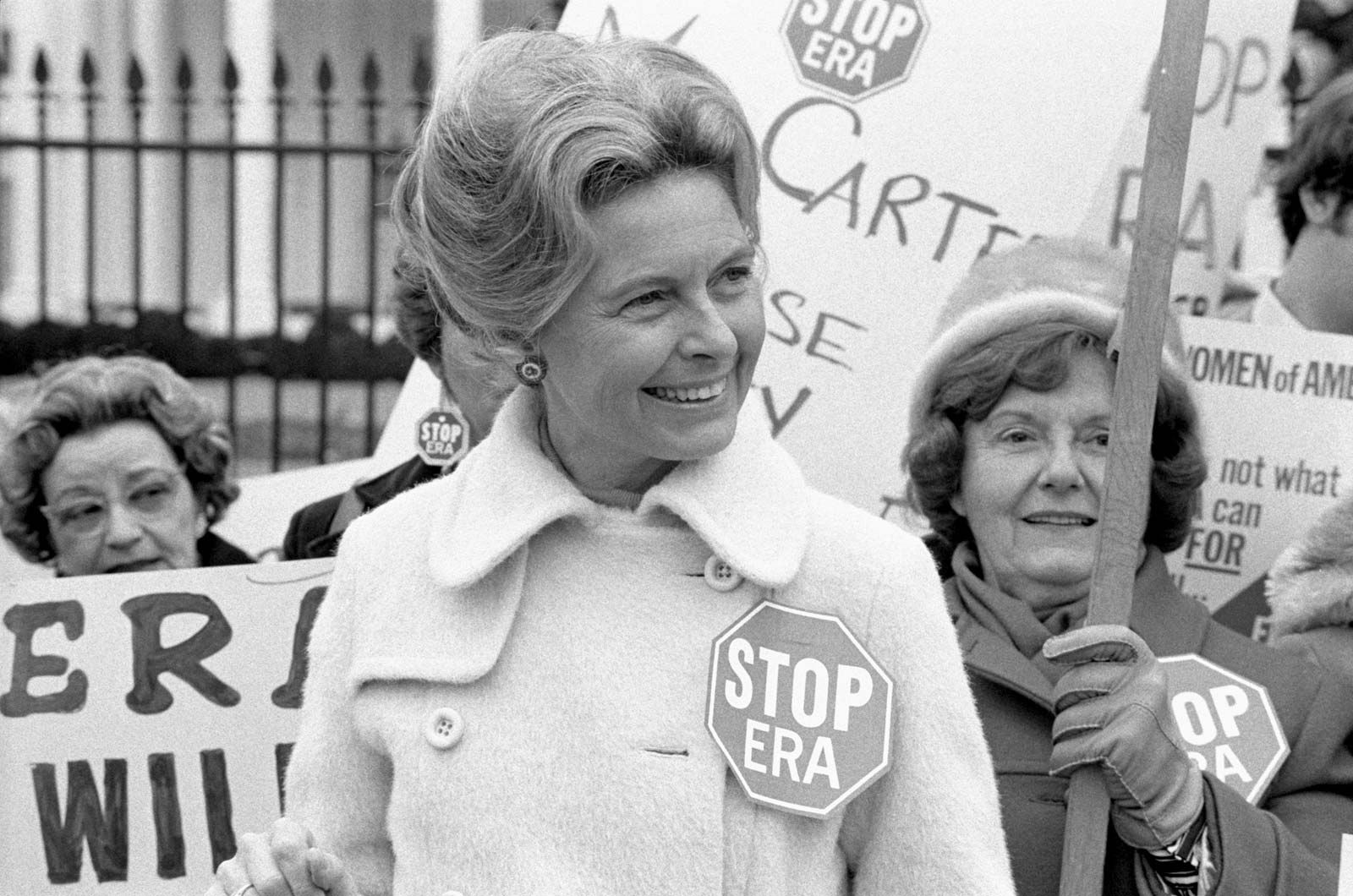
“How many disasters could be avoided if only we could look into the future and get a preview of the consequences of our actions”
-Phyllis Schlafly
Schlafly, arguably one of the most influential figures in grassroots conservatism, helped form the GOP into the conservative party of America. In fact, historians speculate that Ronald Reagan may never have won the 1980 presidential election were it not for Schlafly’s numerous speeches, books, and monthly written reports. Schlafly’s concern for conservative values like limited government, free-market capitalism, and religious freedom supported Reagan’s campaign to make America great again.
A devout wife and mother to six children, Schlafly was also a brilliant intellectual, studying government at Harvard and law at Washington University. Her love for God, America, and the family formed the basis of her political philosophy.
With the rise of the feminist movement in the 1960s, more American politicians and citizens began vouching their support for the Equal Rights Amendment (ERA). Upon acceptance, the ERA would become the 27th Amendment to the United States Constitution, stating “Equality of rights under the law shall not be denied or abridged by the United States or by any state on the account of sex.”
Zealously opposing the amendment, Schlafly quickly became a prominent figure in the public square in the late ‘60s and early ‘70s. As women “liberationists” protested in the streets advocating for the ERA, Schlafly started her own anti-feminist, pro-family campaign. When the amendment had already been adopted by 28 of the 38 states necessary for ratification, Schlafly spoke before legislatures and on television, warning Americans about the consequences that would follow if the ERA were enshrined in the Constitution.
Around this time Schlafly began releasing her monthly newsletter The Phyllis Schlafly Report, where she discussed political and social issues, even continuing to release these reports up until her death in 2016.
In November 1972, Schlafly released a piece entitled “The Right to Be a Woman.” She demonstrated that the Equal Right Amendment would not increase women’s opportunities or improve their well-being (as many wrongly supposed it would). On the contrary, the ERA would wipe out many of the rights and freedoms women enjoyed.
Schlafly explained that erasing the distinction between men and women under law would “impose a doctrinaire equality on the sexes and prohibit the law from imposing any obligations on one sex which it does not impose equally on the other sex.” This regulation would result in women being subject to the military draft just like men. Likewise, husbands would no longer be required to pay alimony to their wives after divorce.
While Schlafly believed the ERA would hurt women, she also believed it would ultimately undermine the family. Schlafly emphasized throughout her campaigns that the family is the center of society in America; therefore, legislation that hurts families and familial relationships would undoubtedly be a peril to the welfare of the nation. Schlafly quoted Paul Freund, a leading Constitutional scholar and Harvard Law professor at the time, to demonstrate how the ERA would devastatingly affect the everyday lives of women and families:
“A doctrinaire equality…is the theme of the Amendment. And so women must be admitted to West Point on a parity with men; women must be conscripted for military service equally with men;… girls must be eligible for the same athletic teams as boys in the public schools and state universities:… and life insurance commissioners may not continue to approve lower life insurance premiums for women (based on greater life expectancy) – all by command of the Federal Constitution.”
Freund argued that the ERA would have long-lasting, dire implications. He predicted that since separate spaces for men and women may be considered as discrimination on the basis of sex, it would follow that separate restrooms for women would be unconstitutional. Similarly, separate athletic competitions for men and women would be discriminatory under the ERA.
Women would be forced to compete against men in sports. Thus, the ERA is not merely a statement that men and women are of equal value or worth, but rather that women and men are equal in needs and responsibilities. Legislation could no longer use the word “man” or “woman.” America would become a gender-neutral society.
In a sense, the former Supreme Court Justice Ruth Bader Ginsburg is the embodiment of the Equal Rights Amendment. The feminist icon of the left and “the notorious RBG,” Ginsburg fought for “the equality principle” from the early ‘70s until her death in 2020. Ginsburg was the antithesis of Schlafly. While they both attended Harvard and became successful attorneys, Ginsburg and Schlafly had completely contrary visions for the future of America. Schlafly was a traditional wife and mother, striving to preserve God’s beautiful design for men and women as laid out in Scripture. On the other hand, Ginsburg sought to pervert the family structure, erasing the distinctions between men and women.
In Schlafly’s article “How the Feminists Want to Change Our Laws,” she explained the radical liberal philosophy which undergirded Ginsburg’s judicial decisions. Ginsburg sought to destroy the Biblical view of the family, ridding of legislation that framed the husband as the primary breadwinner and the wife as the primary homemaker. Ginsburg believed women should be subject to the draft since that is the natural consequence of ridding discrimination on the basis of sex: “Equal rights and responsibilities for men and women implies that women must be subject to the draft registration.”
Additionally, Ginsburg wanted to legalize prostitution and lower the age of consent for sexual acts to twelve years old. She thought any single-sex institutions were discriminatory, and thus prisons should be sex integrated. Any single-sex schools or education clubs were also discriminatory, including Boys Scouts and Girls Scouts. Ginsburg also supported tax-funded abortions as a constitutional right.
Ginsburg was not the champion fighting for freedom as the movie “On the Basis of Sex” paints her to be. Her political philosophy was based upon a false view of man and woman, where men and women have neither distinct rights nor distinct responsibilities. And while Ginsburg never ruled in a case on men in women’s bathrooms or men in women’s sports, her record suggests that she would have been in favor of them. Any legislation that differentiated between men and women, including having separate spaces for the two genders, was – in her opinion – inherently discriminatory.
It is fascinating that Ginsburg often quoted a famous line of Freund’s in support of her liberal decisions: “[the U.S. Supreme Court] should never be influenced by the weather of the day but inevitably they will be influenced by the climate of the era.” Ginsburg made mention of this quote shortly after ruling in favor of same-sex marriage in Obergefell vs. Hodges. She sought to make the point that same-sex marriage should now be acceptable under the law because the American culture accepts same-sex marriage. In other words, the law is downstream from culture.
The seed of Ginsburg’s philosophy bears its fruit in the era of today. While the climate in the late ‘70s and early ‘80s ended up rejecting the ERA, the climate of today has accepted the ERA’s undermining philosophy. The two cultural issues that Freund predicted – men in women’s bathrooms and men in women’s sports – are today a reality.
The Equal Rights Amendment may never have been enshrined into our Constitution, but its legacy lives in our culture. Schlafly prophesied what would occur if America accepted men and women as exactly alike. Not only would women be stripped of the right to stay at home with their children (by being subject to the draft and forced into the workplace after a divorce), but they would no longer have private spaces for their protection.
Like the sons of Issachar in 1 Chronicles 12:32, Schlafly and Freund understood the times and correctly foresaw what would occur in a gender-neutral society.
Rather than seeking the well-being of women, our society is moving toward treating women as if they were men. We should be asking ourselves, as Schlafly did, “Does [a woman] have the right to be treated as a woman – by her family, by society, and by the law? Surely the right to be a woman should be sacred as the right to be treated like a man.”