To anyone with even a scant interest in politics, the current situation appears as nothing short of a hotly contested mess. Most major news outlets, whether on the right or the left, present government and civic disputes as irrevocably divided. The monstrous gorge between the two parties often comes across as having too great a depth and too wide of a breadth to be crossed. In the past few months alone, this gap had only seemingly been widened by the surge of migrants on American borders, the Israeli-Hamas war, and the election of new House Speaker Mike Johnson. This is exacerbated by the ages-old tradition of politics and culture bleeding together so thoroughly that most media commentators attribute their political opinions as being founded upon their moral beliefs. As a result, civic confrontations rarely result in either side changing their opinion, but only further accentuate society’s relativistic morals. The situation appears bleak for any hope of reconciling the citizenry with itself. So, with times like these, who needs the fall of Rome?
Yet, out of the chaos of American political identity, an interesting and novel movement has cropped up. It is a swampy mixture of both Republican and Democrat values; it cherry-picks philosophies from each political sect and blends them. It is a political sensibility that is extremely difficult to define because it does not abide by a mainstream standard of principles. However, this may be its most attractive feature. Unlike the hard, contentious party lines drawn by both the right and left, this new purple movement encourages obscure stances. In an era of chiseled political orders that demand an all-or-nothing-at-all level of commitment, many average Americans have found comfort in the indistinguishable, the hazy, the in-between. This coalition may be broadly placed under the heading of Populism, encouraging the vague and flexible discussions that challenge typical expectations.
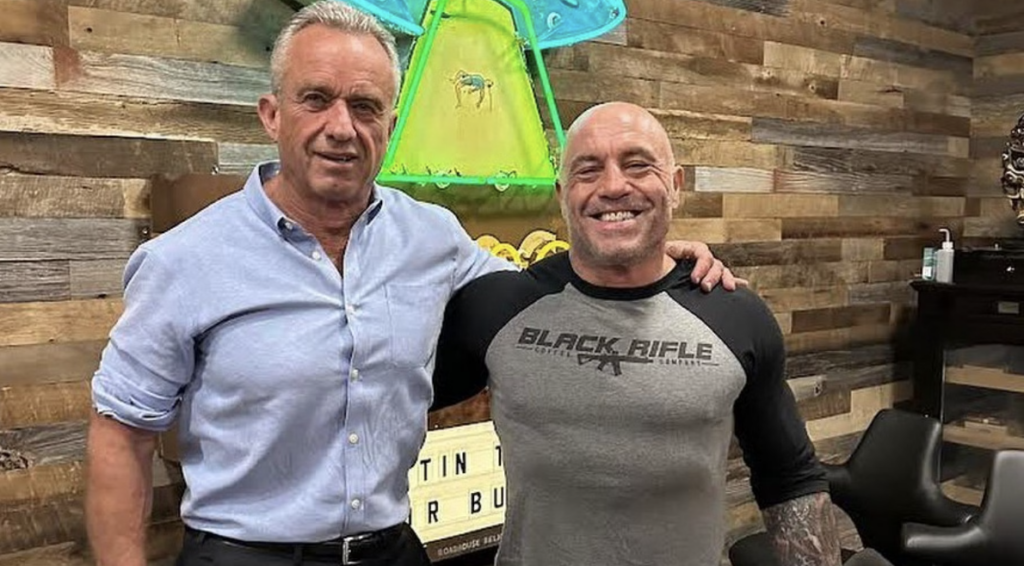
Two chief figures have emerged as the champions of Populism, a prizefighter and a power player: Joe Rogan and Robert F. Kennedy Jr. Both men have been rejected by the dominant political parties yet have surged in popularity and support. Rogan has gained prominence as a jack of all trades who has excelled in fighting, stand-up, and long-form podcasting. Kennedy has become a modern marvel in the world of presidential candidacy since he announced his third-party run for 2024. While neither man adheres to strict philosophies on culture or politics, this is the very characteristic that unites them. Their unwillingness to stagnate their ideologies by blocking out opposition has become very attractive amidst the current chaos. Their readiness to face the challenges of opposition often highlights their humanity. It demonstrates a disposition that favors opening their beliefs up to criticism in favor of unearthing core truths.
Rogan has notoriously become an icon of discourse. On his podcast, the aptly named ‘Joe Rogan Experience’, listeners enjoy hours-long interviews between Rogan and his guests. The conversations are as varied as the guests, featuring debates about the existence of aliens, the pandemonium around COVID-19, and the relevance of cancel culture, with notable figures such as Kanye West, Jordan Peterson, and Elon Musk. The podcast takes a fascinating dive into its subjects, and because they are not bound by limitations on length, podcasts allow for ideas to be fully fleshed out, challenged, and understood in totality.
In 2016 and 2020, the relevancy of presidential debates, for both the primaries and the general election, were increasingly questioned. Often, the so-called debates divulged into embarrassing jumbles of yelling pockmarked with the occasional witty, snide remark that would be pulled for news segments the following day. Still, the overwhelming problem with these debates were their glaring omission of actual insight into the candidates. In an attempt to get in a knife-twisting joke or to account for the opinions of the plethora of people on the debate stage, any actual truths about the candidates became obscured. The entertainment value of these public spectacles may have been high, but they were merely that- spectacles.
Rogan’s podcast rose from the ashes of the once relevant and succinct tradition of presidential debate. Through his hours-long, well-researched podcasts, the people he interviews are given the ability to fully explicate their ideas. The conversations Rogan hosts are insightful, engaging, and approachable, something the public can thoughtfully partake in, even as a third-party observer. As a result, many of his interviewees stances on politics and culture come across as being far more nuanced than they might otherwise appear. The lengthy dialectical process uses conversation to unearth a profound portion of depth. For Americans, peeling back the shoddy veneer of vain zingers and skimpy explanations is refreshing. Rogan’s podcast, which still breathes with moments of humor and interesting asides, has given people room to linger in the murky in-betweens of politics.
Perhaps the Populist movement witnessed the fullest actualization of this new discourse when Rogan spent upwards of three hours interviewing RFK Jr. Their highly anticipated discussion was noteworthy because it was one of the first times in decades that RFK Jr. had the opportunity to wholly flesh out his opinions on a major media platform. The two men discussed vaccines, environmental issues, and censorship. Although Kennedy’s perspectives still veered towards the political left, his refusal to wholly cooperate with the Democratic party’s ideology was glaring. The left rarely attempts to contradict itself, maintaining an austere set of talking points, meaning that RFK Jr.’s slight, slight push towards the center of the aisle resulted in his ouster from their ranks. Throughout the podcast, the two men didn’t shy away from addressing some of the major criticisms and controversies surrounding both of their careers. The episode was widely popular, drawing both praise and critique from both sides of the political aisle.
However, the actual content was not as notable as the inherent success of its basic premise. Rogan’s podcast, despite consistent popularity, is not a part of the mainstream media, meaning that this particular podcast utilized non-traditional means to communicate RFK Jr.’s message with the American public. Essentially, the existence and reception of the conversation was as radical as the dialogue itself. It presented the public with an avenue for understanding politics that was not reliant on multi-million-dollar media monsters. It was a triumph for the Populists, who wanted nothing more than an honest look at RFK Jr. and a compelling examination from Rogan.
In a recent poll from Quinnipiac[1], RFK Jr. was found to be polling at around twenty-two percent when factored into a three-way race between him, Joe Biden, and Donald Trump. This enormous surge in polling comes as a shock to both the Republican and Democratic parties, as RFK Jr. is building a coalition from both sides of the aisle. Voters who are unsatisfied with Biden and Trump, who each have controversial Presidential histories that can be summoned and probed, may find consolation in RFK Jr. As an independent, he does not carry the weight of an established political party, and the hopeful promises he makes generate high expectations. With RFK Jr. in the picture, suddenly the political gorge doesn’t seem quite so wide.
Perhaps Populism’s success will ultimately be the very thing that leads to its demise. It doesn’t have a classically pure set of principles, and its values vary from person to person. It is an ambiguous movement, which allows it to draw in support from all sides while also crippling its ability to expand in a mainstream manner. Yet, its popularity continues to rise, and even its most staunch critics cannot deny how notable its key figures have become recently. The political climate is extremely divisive, and the purple revolution which champions subtlety and suspicion, comes across as a tract of repose for those who feel their voices and questions have been hushed.
[1] Malloy, Tim. General Election With Independent Candidates (November 1, 2023), Distributed by Quinnipiac University, https://poll.qu.edu/poll-release?releaseid=3881