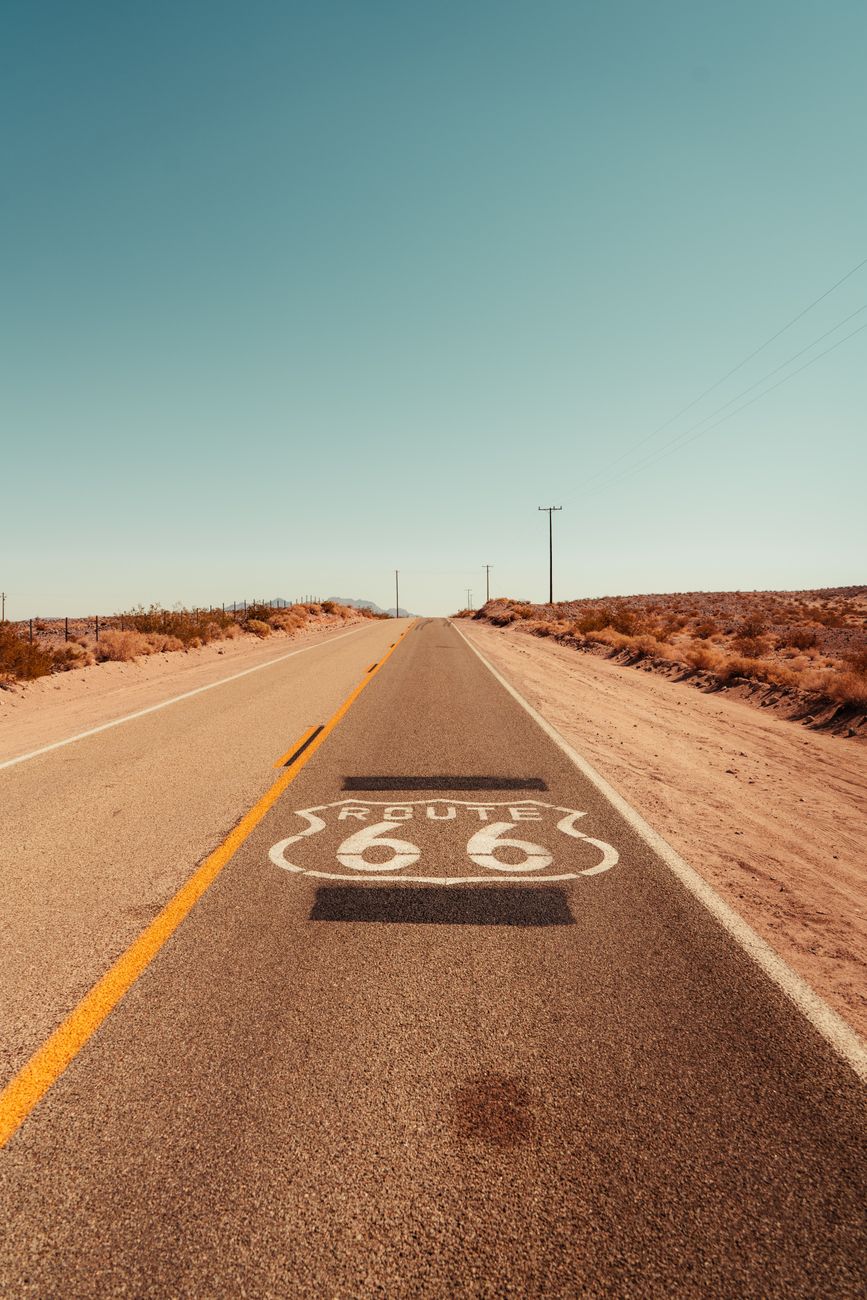
If you ever plan to motor west, sings the silky smooth voice of Nat King Cole, take my way, that’s the highway that’s the best.
Were the midcentury crooner still here today, he would be disappointed to find that no one is getting their kicks on Route 66 anymore. A string of six-lane highway projects killed what was once the heart of America. Over the course of several decades, the construction of I-40 rerouted, repaved, and rolled right past the original Route 66. After the highway was officially decommissioned in 1985, major stretches of the road were left to crumble, trampled into dirt roads, or leading to dead ends.
As America marches forward into its next 250 years, it can be easy to overlook the successes of the past in favor of worrying about the future of the nation. We’re faced with endless controversies, from podcast wars to nuclear ones, the rise of communism to the fall of the nuclear family. Some of our concerns can be quelled by looking to the past. Scattered throughout the pages of old letters and built in the skyscrapers of our greatest cities, our forefathers have given us the blueprint for progress.
Americans are the descendants of pilgrims. The original Pilgrims, a group of English Separatist Puritans, sailed across the Atlantic ocean in the now-famous Mayflower in hopes of finding a land where they were free to worship God. Their journey led to the first permanent English settlement, and their subsequent Mayflower Compact, imposing a framework of self-government and Christian citizenship, led to our modern constitutional republic. Their children were farmers, free-thinkers, and explorers. New colonies were established, mountains were crossed, wilderness was tamed, and slowly the American people developed their identity.
The American Manifest Destiny is no small thing. In part, the Revolutionary War was fought to allow settlers to continue pushing west across the Appalachian mountains. Thomas Jefferson’s Louisiana Purchase doubled the size of the young country, giving Americans vast swaths of land to explore. The Mexican-American War finally allowed the U.S. to stretch from sea to shining sea, acquiring much of the present day southwest and the current California coastline. In due time, America would give statehood to Hawaii and Alaska, expanding its borders and giving its people new spaces to traverse. In 1969, we planted our flag on the moon, and millions of people got to partake in the next milestone of American exceptionalism.
A little bit of that pilgrim blood runs through all of our veins. When we look ahead to the future, we think of Elon Musk who wants to build colonies on Mars or people who prefer the notion of deep sea submarines discovering ancient aquatic marine life. These are noble, worthwhile pursuits; but for the average American, the dream of heading to space or uncovering lost empires in the style of Indiana Jones is far-fetched.
The great American road trip was the symbol of the pioneer spirit during the 20th century. Route 66 was particularly providential, as it stretched from Chicago to L.A., more than two thousand miles along the way, as the song says. It carried hundreds of thousands of midwestern families and east coast expeditionists across western America. It was lined with roadside oddities like the Blue Whale of Catoosa, the Cadillac Ranch in Amarillo, or any number of fibreglass statues designed to make tourists pull over. Hundreds of independently run gas stations, run by local families, lined the highway. Voyageurs found small, relatively cheap hotels, who found their niche in kitsch, like with the WigWam Motel in Holbrook. Mom and pop diners stayed open late, selling burgers, french fries, and slices of pie to hungry travellers.
Route 66 is often considered the height of Americana. The highway created a culture that was entirely unique to America. It could only be born out of a country so large, so strange, and so curious that its people would find pleasure in the boundless open roads it presented. For some people, it was a once-in-a-lifetime journey, while others traversed it annually.
But as Clark Griswold put it in “National Lampoon’s Vacation”: “This is no longer a vacation, it’s a quest.” Route 66 was a small way for people to take part in the great American quest. It allowed them to go west, the way their fathers and forefathers had. While road trips are still popular, ebbing and flowing each year, they are more expensive, more planned, and less spontaneous than they used to be. Hotels are booked months in advance, drive times and scheduled to the minute, and air travel is generally more practical. However, those things are vacations, not quests. They don’t give travelers the opportunity to see St. Louis, Barstow, and San Bernardino, and they don’t satisfy our desire for manifest destiny.
Route 66 may be gone, but the all-American need to be pilgrims and pioneers will never go away. Our nation is covered with countless tiny towns and historic Main Streets, filled with patriotism and pleasant wonders. It is our duty to continue to explore those towns throughout this country and to keep the quirks of Americana alive. Get your kicks and carry on the spirit of 1776.