Adapting great works of literature can produce timeless rewards, yet always runs a great risk. Ever since movies emerged in the late 19th century, artists have attempted to turn the stories they loved into major motion pictures. Sometimes, they turn into era-defining epics. The four-hour long adaptation of Gone With the Wind is still the highest grossing movie of all time when adjusted for inflation. Other books, like the Godfather and The Lord of the Rings, inspired multiple movies, giving their characters more opportunities to become fleshed out.
Naturally, this isn’t always the case. The Great Gatsby has been notoriously hard to adapt, with most movie versions falling flat despite their best efforts. Ernest Hemingway was famously wary about any adaptations of his writing; despite the movies based on his books becoming box office successes, he was dissatisfied with how the movie studios translated and changed his work. J.D. Salinger barred his bestselling novel, The Catcher in the Rye, from ever becoming a movie. One of Salinger’s earlier short stories was turned into the film My Foolish Heart. When Salinger saw it, he called it a “bastardization” of his work and abandoned Hollywood’s beckon for good.
It was a bold decision for Angel Studios to help produce a screen adaptation of Animal Farm. The original 1945 novella is a rich study in socialism, communism, dictatorships, and collectivism. Written in the wake of World War II and at the beginning of the Cold War, its author George Orwell tried “to fuse political purpose and artistic purpose into one whole.”
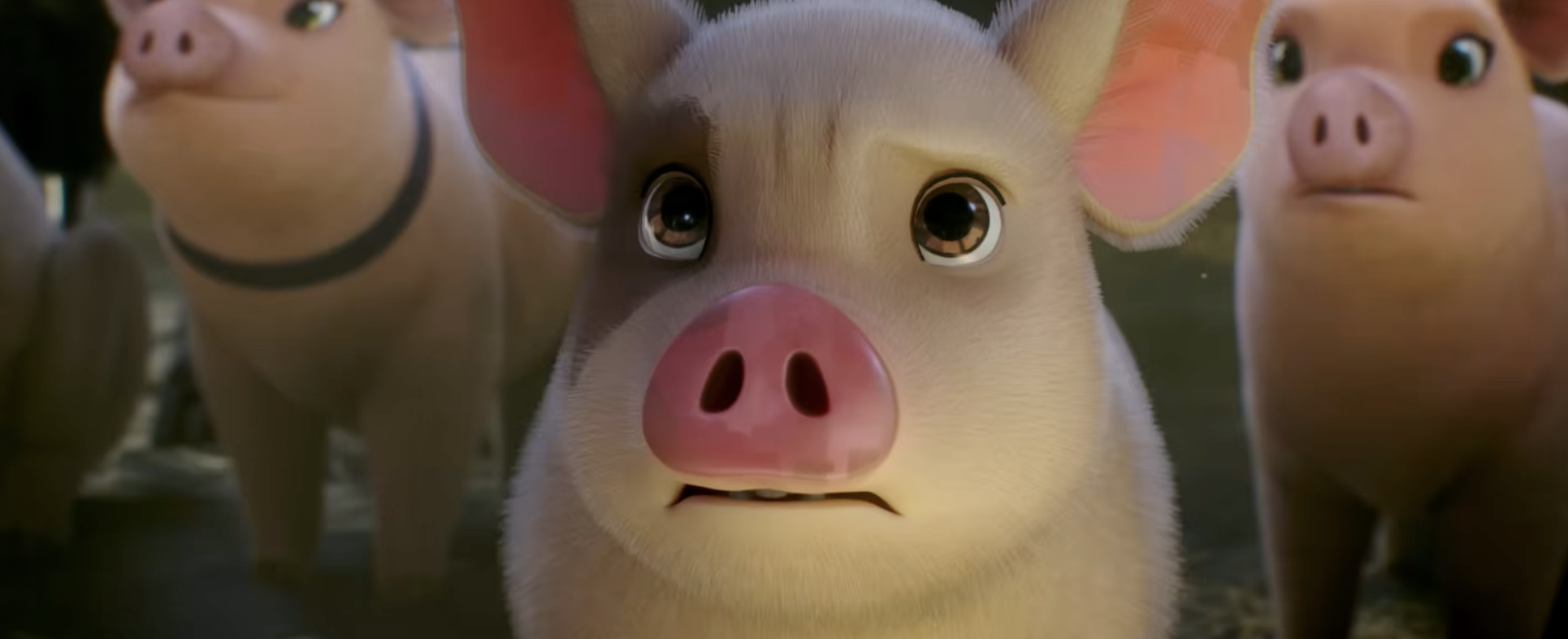
When the Animal Farm film trailer debuted this past week, it was hard for people not to approach it with respectful caution. Whenever works of literature are adapted, it changes the aesthetics, the characters, and the meaning. Changing the medium behind an art piece inevitably changes its interpretation. It’s akin to rewriting history. The original novella was a serious work, layered with irony, forged out of a tense social and political context.
The trailer denies its source material. Animal Farm has been read amongst middle schoolers and pre-teens for quite some time, so the use of animation isn’t totally subversive. However, it has a glossy sheen that impales artistic integrity on a spear of commercial appeal. The cutesy character designs fit comfortably with the dimwitted sense of humor that would receive eye rolls from anyone over the age of eight. The pop song “Feel It Still” drones on in the background, something that doesn’t seem to mesh well with a critique on the Russian political climate. When the name “Seth Rogen” flashes on screen as the headlining cast member, it’s hard not to feel as though this is a deliberate misinterpretation.
Underlying these artistic shortcomings, the trailer reveals how the plot of the story has been changed. The “new” Animal Farm turns the animals against “greedy” humans. It changes the meaning of the story entirely: It no longer depicts the horrors of a communist dictatorship but the “horrors” of capitalism. Money and success are the enemy. A malicious businesswoman is the antagonist who corrupts the powerful pig Napoleon.
The Left has been trying to turn America against the free market. It’s why New York City elected its first ever socialist mayor this past fall. It’s why Bernie Sanders and AOC maintain a cultlike following. It’s why free childcare, free healthcare, and rent control have become key talking points among Democrats. They have to destroy the freedoms of capitalism in pursuit of equity. A decade ago, it would have been unthinkable that movie stars and major studios would create propaganda that so clearly attacks the American way of life. Now, it feels like the next logical step for a political party obsessed with control.
Like Orwell’s own era, ours, too, is quite tense. There is endless political infighting, the looming threat of violence, and terms like ‘fascist!’ being lobbed back and forth. This is one of humanity’s ongoing plights. The problem is that the American people are starting to buy the lie of equity instead of equality. They believe that socialism is the answer to the problems of inflation, decades long mortgages, and stagnant job markets. This adaptation of Animal Farm is choosing to misinterpret its source material. It’s trying to change the story’s meaning so that it can convince people that socialism is good.
Don’t let the cartoon eyes fool you.