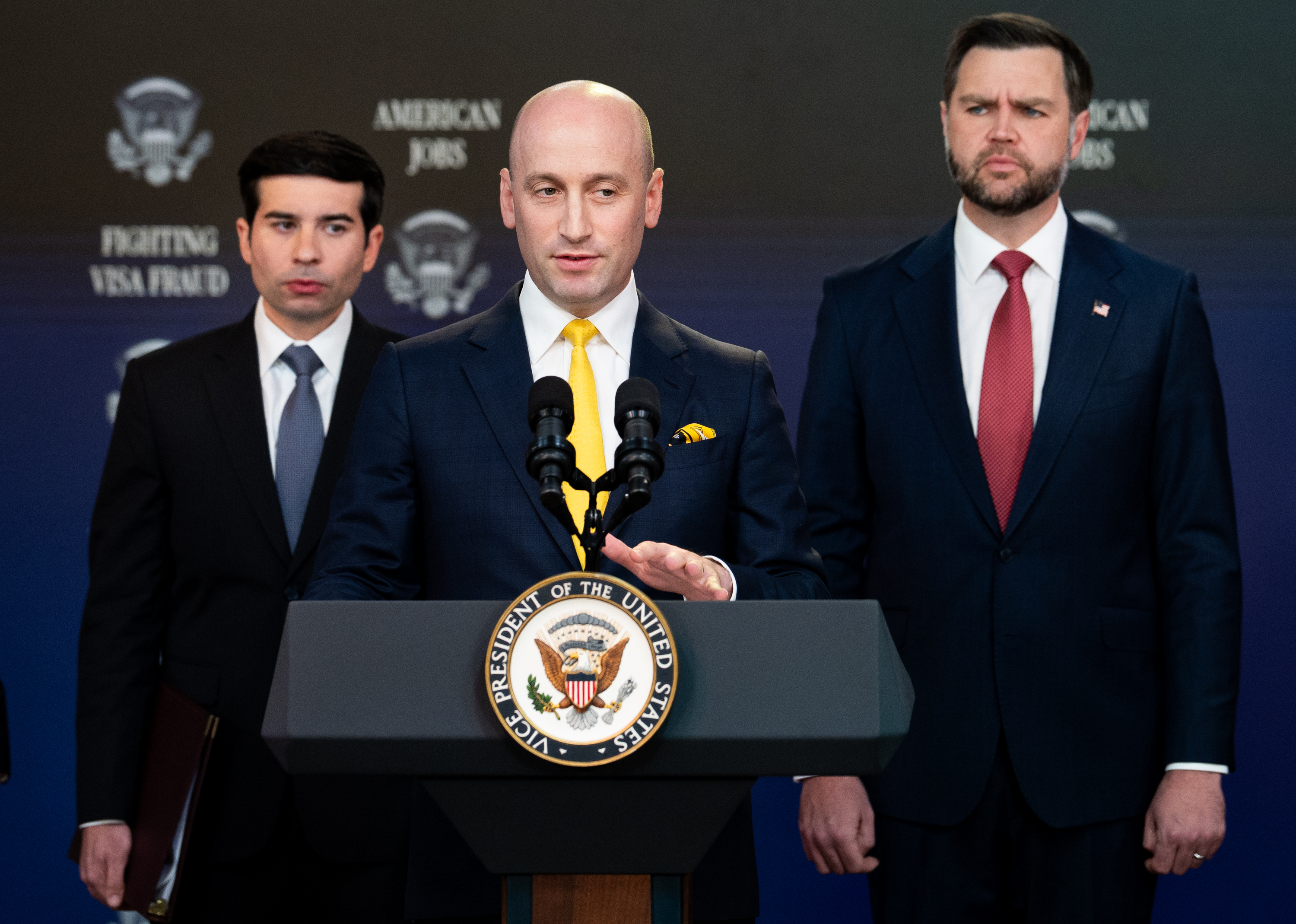
When Attorney General Todd Blanche arrived at the Ritz Carlton in Pentagon City for the America First Legal gala, he wasn’t wearing formal attire. The Wednesday evening gathering in late September brought together senior Department of Justice officials and legal staff from across the administration, and even the Attorney General. But the person who commanded the most attention–and was responsible for the Attorney General’s outfit–was the youngest and one of the few without a law degree. Blanche remarked that Stephen Miller told him not to bother with formal wear.
Five weeks later, Republicans suffered a decisive defeat on Election Day, and within a few days the Trump Administration quickly made moves to combat the Democratic dynasty soon taking over. The first and most lethal weapon President Trump has deployed: newly-appointed Chief of Staff Stephen Miller.
“I wanted to make a change,” President Trump told us on the South Lawn when asked about the appointment. “I think Susie has done a very good job, but… We gotta make moves. Sometimes in life, you have to make moves.”
There is no doubt this shift in personnel is the reenergization the MAGA base needed after Tuesday. Miller steps up to this role with the youthful, relentless energy and loyalty the White House and the entirety of the GOP needs now more than ever to revive the confidence and momentum needed to survive the next two years. Elevating Stephen Miller may prove a greater asset to Trump than the midterms proved a liability.
Miller’s relentless loyalty leaves him almost overqualified for this position. Miller has been at Trump’s side since the 2016 campaign, when he joined as a speechwriter and quickly became a central voice on immigration and national sovereignty. During the first term he served as a senior advisor, serving as a major architect on policies from the travel restrictions to border security measures. Between the Trump administrations, he co-founded America First Legal to litigate in defense of the MAGA agenda. After Trump’s 2024 victory he returned as Deputy Chief of Staff for Policy, where I’ve reported on his work and watched him drive the administration’s enforcement agenda from the outset. This combination of long service, policy expertise, and outside advocacy makes him uniquely prepared for the role he assumes on Monday.
Take it from his business partner, President and Co-founder of America First Legal Gene Hamilton. Calling him a “patriot’s patriot”, Hamilton stated “There is no one better suited for this role at this time. We founded America First Legal to fight for the American people, and Stephen’s dedication, vision, and tireless work ethic have defined his career in service to this country.”
The greatest endorsements of the appointment have come from its critics. Democratic leaders responded with predictable intensity. House Minority Leader Hakeem Jeffries called Miller “a dangerous xenophobe and reckless extremist,” while Senate Minority Leader Chuck Schumer said the president “learned nothing” and “couldn’t have made a worse choice.” Even some Republicans who favor more expansive legal pathways for long-term residents have objected. Indiana Rep. Marlin Stutzman, a co-sponsor of the Dignity Act and someone who earlier this week said Miller should be fired, called the elevation a “horrible decision.” When opponents who prefer softer enforcement or broader legalization single out Miller, it is a reliable signal that he will be a powerhouse in carrying out the enforcement mandate on which the president campaigned.
While the appointment is widely viewed as preparation for dealing with a Democratic 120th Congress, the more urgent window is the next two months. Miller is stepping into the job with substantial resources already in place.
As of September 30, Office of Management and Budget data showed roughly $160 billion in unobligated funds across Department of Homeland Security multiyear accounts from the One Big Beautiful Bill and the Secure America Act. Much of that money is restricted to narrower purposes such as border barrier construction, yet substantial amounts were appropriated for detention, transportation, hiring, and technology.
ICE itself still held approximately $33 billion in unobligated Secure America Act funding at the end of September, enough to help sustain operations into 2028 if spending remains near recent levels, with additional One Big Beautiful Bill funds remaining legally available through January 2029. After covering continuing operations at roughly FY2026 cost levels, the remaining ICE and secretary-level multiyear balances plus some CBP operating funds could leave roughly $60 billion available for an expanded removal effort.
Those resources are matched by operational capacity. More than 2,700 287(g) agreements are now active across the country, authorizing state and local law enforcement agencies to assist ICE in identifying and processing removable aliens under federal supervision. Combined with the multiyear appropriations already on the books, the legal and financial foundation for large-scale interior enforcement exists today.
Between Stephen Miller, the estimated $60 billion available for expanded removals, and over 2,700 287(g) agreements, President Trump has the personnel, funding, and partnerships needed to prioritize the removal of criminal aliens and restore relentless enforcement of immigration law.
With a Democratic Congress and new governorships arriving in less than two months, however, the window is finite. Once the new majorities are seated, oversight, appropriations fights, and potential legislative restrictions will complicate rapid action. The remaining obstacle is political will. That will is now embodied in the Chief of Staff.
Between Miller, the funding already appropriated, and more than 2,700 287(g) agreements, the tools for large-scale enforcement are in hand. The only question is whether they will be used before the Democratic Congress is seated. With Miller now Chief of Staff, the answer is no longer in doubt. It is Miller’s time.