Men and women hate each other. At least, this is what young people are led to believe. The 2024 election saw young voters divided on the most fundamental questions – marriage, family, and abortion – making questions of human life and existence, and with them civilizational survival, central to our politics.
Young men are conservative and shifting further right, while young women are liberal and lurching leftward. As a result, politics seems to be about merely living, rather than living well. The “gender divide” isn’t just a headline; it’s a felt fact of contemporary life, and it threatens to undo our experiment in ordered liberty and self-government.
But what does it mean to have a “gender divide?” What constitutes “gender,” what defines its parameters, what forms its substance? What does it mean for men and women to be “divided” along those categories? And, perhaps most importantly, what is a way forward?
These divisions can be understood, like many things, by returning to the beginning — the very beginning.
The word “gender,” like the word “genesis,” is rooted in the Proto-Indo-European prefix “gen-,” meaning “beginning,” or “birth.” In the book of Genesis, the origin of “gender” is revealed not through abstract notions of “man” and “woman” but through people, relationships, and obligations. Herein lies stability and unity, which could soothe the current strain between the sexes.
On the sixth day, after God created the heavens and the earth, He made mankind in His image. He created two beings, a male and a female, and He gave two commands: “go forth and multiply” and “have dominion…over every creeping thing that creepeth upon the earth.” Soon after creation, humans were beckoned toward yet more creation and were given two things: life and purpose. The former gives them being, and the second orders their doing.
Still, the question remains: What are these beings? The second chapter makes this clearer. Following this cosmological spectacle of Creation is a character drama of the created. Here, the perspective shifts from God to Man, from heaven to earth. While Adam tends to the garden and names the earth’s animals, God decides that he needs a “help meet,” the first woman, whom He forms out of Adam’s rib. Adam describes her as “bone of my bones” and “flesh of my flesh.” Although distinct beings, they share a common humanity directed toward a specific purpose. “Therefore,” the chapter continues, “shall a man leave his father and his mother, and shall cleave unto his wife: and they shall be one flesh.”
In Genesis, there is no abstract notion of “man” or “woman.” There is husband and wife, father and mother, an ordering of mankind toward a set of mutual obligations. They achieve a collective harmony that neither could achieve on his or her own. Through complementary and mutual necessity, they become unified, and through this unity, they find completion.
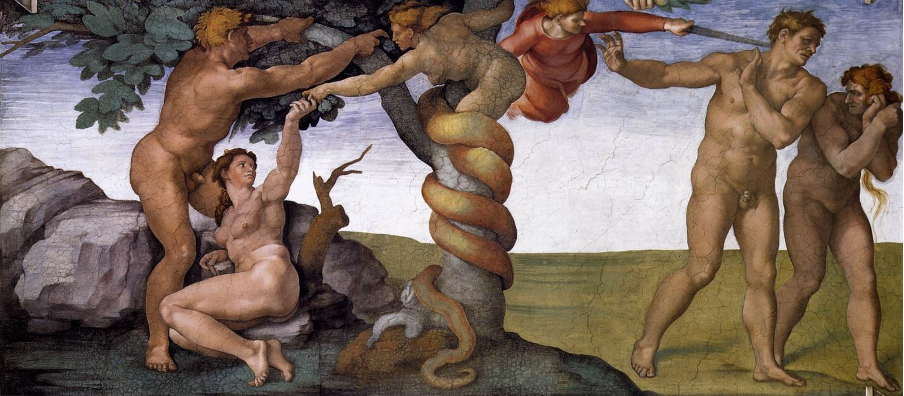
Yet even in Genesis, such harmony is short-lived. Eve is deceived by the serpent and she persuades Adam to eat of the forbidden tree. God thus banishes them from the Garden, telling Adam:
“Because thou hast hearkened unto the voice of thy wife, and hast eaten of the tree…in sorrow shalt thou eat of it all the days of thy life,” and telling his wife, “I will greatly multiply thy sorrow and thy conception; in sorrow thou shalt bring forth children; and thy desire shall be to thy husband, and he shall rule over thee.”
The united flesh is once again divided.
Significantly, however, Adam and Eve fell together, and through this unity in depravity they attempt reconciliation. Shortly after their punishment, Adam “knew his wife,” and she gave birth to Cain, the first man born into original sin. They soon welcomed a second son, Abel.
However, after God rejects Cain’s offering in favor of Abel’s, Cain kills his brother out of jealousy, making the first murder not just a homicide, but a fratricide. In this act lies a terrible lesson for all of God’s fallen creatures: When we sin against our fellow man, we sin against our brother.
The Genesis narrative shows us that we were not created to inhabit vague, abstract notions of gendered being. We may, and will, exhibit characteristics that are traditionally “masculine” or “feminine,” but these traits should be in service of, and grow naturally from, our relationships with others. Most importantly, we are children of God and, and we must respect the innate dignity, and fraternity, that connects us all.
The Apostle Paul champions this account of human relationships in the New Testament. He often addresses his letters to “brethren in Christ,” meaning adelphoi, or people “from the same womb.” To Paul, Christians are not merely united by collective assent to a common belief; they are joined as kin, as fellow members of the body of Christ. The Bible is full of similar familial language. God is our Father. Christ is his Son. The Church is Christ’s bride.
Furthermore, the radical notion of personhood pervades the gospel story, most literally with the incarnate figure of Christ. In Christ, God becomes particular. He takes on flesh and suffers death for the salvation of those who place their faith in Him. Through His crucifixion and resurrection, He births a new people, restoring their relationship with God. Paul writes in Galatians, “ye are all the children of God by faith in Christ Jesus…There is neither Jew nor Greek, there is neither bond nor free, there is neither male nor female: for ye are all one in Christ Jesus.”
And, as John writes, “to those who believed in his name, he gave the right to become children of God – children born not of natural descent, nor of human decision or a husband’s will, but born of God.”
Of course, the descriptive categories of “male” and “female” do not fall away. After Christ, men and women still exist in separate capacities and are called to relationships which give them life, purpose, and hope. Yet, through the second Adam (Christ), the curse of sin and death – that which the first Adam brought upon the world – is broken. Through Christ, we are reconciled, both to each other and to God.
We miss such crucial lessons when we tie ourselves to a universal vision of an Everyman or Everywoman. We distill ourselves and our obligations to warring masculisms and feminisms. By filtering our lives through these abstractions we reduce ourselves to small examples of big phenomena. Instead of working up toward a conception of “man” and “woman,” we work down, imposing general ideas of “masculine” and “feminine” traits on our complicated web of relationships.
Being a “man” ought to mean being a father, a son, a brother, a husband. Being a “woman” ought to mean being a mother, a daughter, a sister, a wife. Just as marriage is said to be a “school of virtue,” so too are the various relationships we share with others. When we wrap ourselves in these relationships, we enroll in this great curriculum. By imposing on ourselves the rigid demands of ideology, we divorce ourselves from these blessings.
Ultimately, we are to be familiar with those we love, not to consider each other examples of an abstract ideal, but as whole, complete persons made in the likeness of God. Our relationships complicate the abstract because they create bonds that surmount our comparative insufficiency to the ideal. They direct our behavior toward the good of others, even if that person fails to live up to generic expectations.
Unfortunately, the gender divide shows no sign of narrowing. Instead of resignation, this encourages us to turn to our origins for wisdom. In the story of Adam, we can find consolation, and in the life of Christ, we will find hope. As we mature, the challenges of family formation and political life will mount.
Yet, for Christians, there is always hope: Hope for the restoration of relationships. Hope for the flourishing of families. And, ultimately, hope for the softening of hearts that have long been hardened.