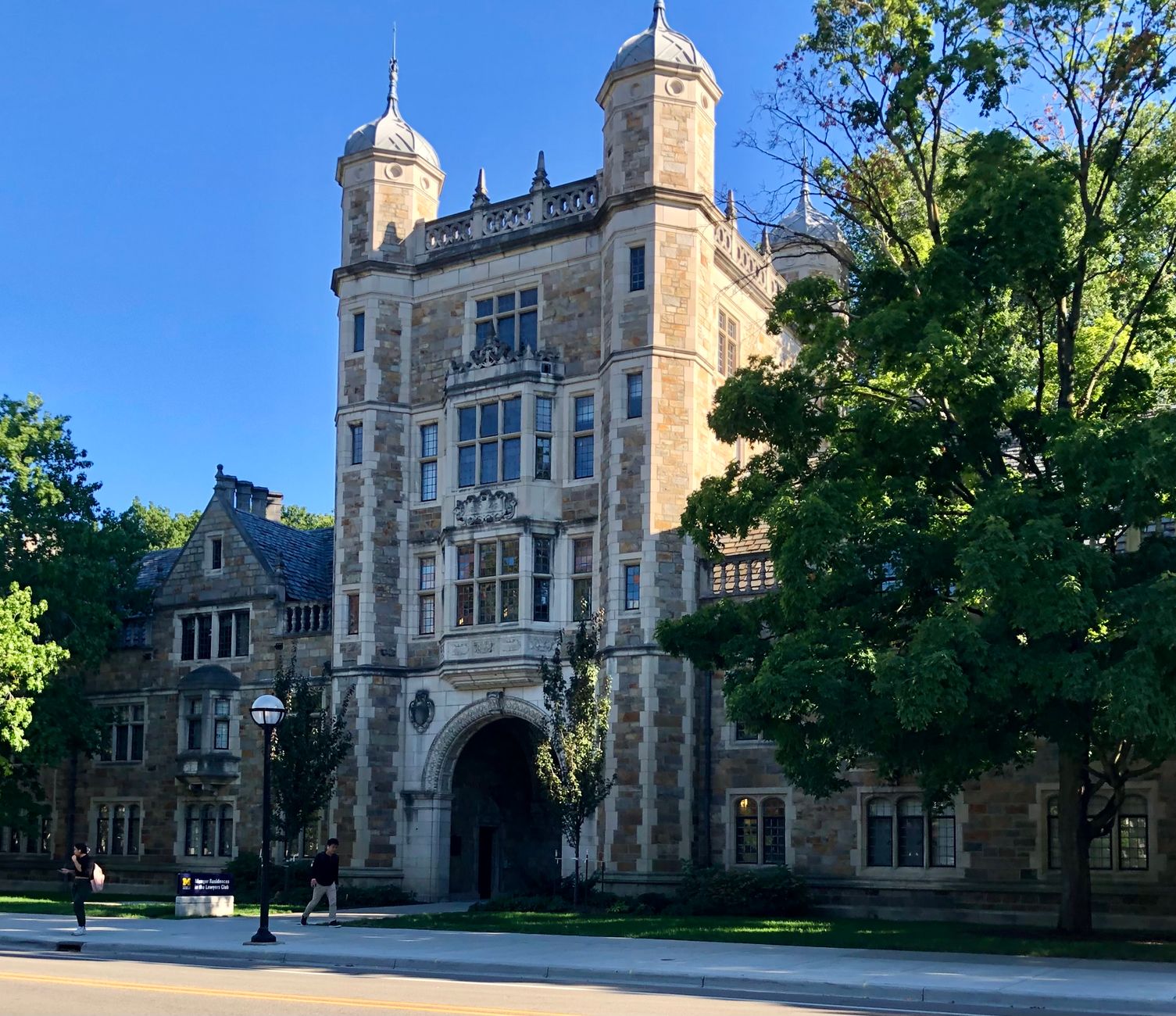
The University of Michigan recently announced a significant change to the way thousands of its freshmen will experience college. Beginning in fall 2027, students in the university’s largest college will not receive traditional letter grades during their first semester. Instead, their transcripts will record either “Pass” or “No Credit.”
Understandably, the transition from high school to college can be brutal. Students leave behind familiar teachers, parents, counselors, routines, and expectations and suddenly find themselves responsible for managing an enormous amount of work on their own. College students deal with burgeoning loneliness and financial pressures amid a generational mental-health crisis that universities can hardly afford to ignore.
If removing letter grades for one semester can make that transition easier, why not do it?
But this is where we need to distinguish between making college more humane and making it less accountable. Michigan’s proposal involves professors who will still grade projects and students who will receive feedback. The fundamental change, therefore, concerns what the student sees on his transcript and what counts toward his GPA. The rationale is understandable —let’s provide a way to allow young adults some breathing room while they adjust to college without allowing one bad semester to follow them forever. I can certainly see the value in that. In fact, I’m entering a classical school that resists the temptation to assign homework.
And yet there’s rather significant danger in confusing the removal of consequences with the removal of pressure. Sometimes the pressure is the thing that tells us we need to change.
I so badly want to say that this is merely an issue in higher education. Unfortunately, I know better.
Over the summer, I worked freelance for a tutoring company. I specifically recall one instance when I worked with a high-school student who, in twelfth grade, still did not know her multiplication facts. Her younger brother, in eighth grade, could perform basic multiplication but struggled to understand what a word problem was actually asking him to do. Neither child deserves to be held up as a cautionary tale about some defective generation of children. What was saddening had nothing to do with the children themselves.
So many adults had apparently looked at these gaps in their education and decided that the appropriate response was simply to move them along. At some point, somebody has to be willing to say, “You don’t know this yet.”
My own college experience made this problem particularly difficult to ignore. I am deeply grateful for much of what my education gave me, and I have a great deal of affection for the experience. I learned an enormous amount, made lifelong friends, and encountered books and ideas that changed the way I see the world. Alongside all of that was an almost comical amount of academic scaffolding designed to accommodate students who sometimes seemed to lack the most basic skills necessary for college-level work.
Much like what I had recently witnessed in tutoring, the institution seemingly decided the appropriate response to their deficiencies was to make the college experience easier, rather than to ask how those deficiencies had survived all the way to college in the first place.
And that brings us back to accountability.
Grades and deadlines provide information. They tell a student what he knows, what he does not know, what he can do, and where he still needs to grow. Remove every unpleasant piece of that information, and you may simply make it harder to tell whether education is happening at all.
This matters even more in the age of artificial intelligence. The command I most want to give students right now is remarkably simple: Don’t let the AI do your homework. It sounds almost perfunctory at this point.
A fascinating chart from The Economist recently made the rounds showing something that should not surprise us. Students using AI could complete homework more quickly and perform better on that homework. But when they subsequently had to perform without the AI, the advantage disappeared—and in the study represented by the chart, the students who had relied on AI performed substantially worse on the exam.
An obvious qualification is needed here. Real life contains far more “homework conditions” than “exam conditions.” Most adults are not going to be locked in a room without Google, ChatGPT, calculators, colleagues, books, or other tools every time they need to solve a problem. Part of education should absolutely involve learning how to use those tools well.
While it’s incredibly easy to make AI the bane of modern society, what’s truly at hand is the consistent removal of academic friction in any sense.
A recent piece in the Religion & Liberty Daily makes a related argument about academic accommodations. The author, Julia LaGrand, argues from her own experience as a blind student that good accommodations can be essential to genuine learning. Her criticism centers on treating accommodations primarily as mechanisms for producing equal outcomes rather than as tools for helping students actually access the educational experience. She argues that professors, who understand the actual demands and purposes of their courses, should have a much greater role in determining how accommodations work.
Funnily enough, we talk constantly about preparing young people for the real world, but the real world is filled with feedback. Employers tell you when your work is inadequate. Customers tell you when your product is bad. Coaches tell you when you are playing poorly. Friends tell you when you have behaved badly. Life itself has an extraordinarily effective grading system, and it does not offer many opportunities to cover the grade.
Perhaps we have mistaken kindness for kindness to the feelings, when education requires kindness to the person.